

Pathogen Update: 7-28-2026
New 4-month forecast and the Daily Automatic Update
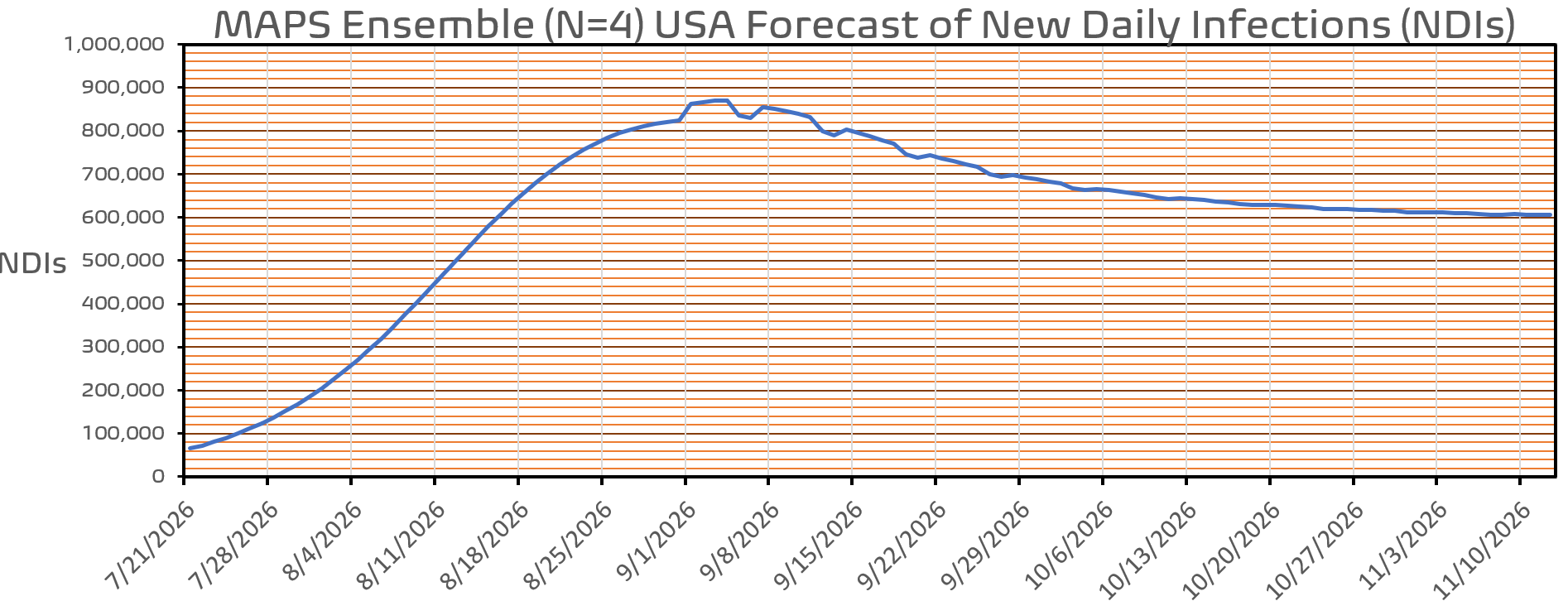
I think the next wave is coming, at least according to my model, MAPS. Below is the animation for the country. Excuse the first timestep; the model is adjusting. I recommend going full screen. I will have regional movies soon. Also shown are the US average NDIs by total and by variant. It appears the dominant variant is XFJ.3, shown in the grey lines, but several others contribute, even NB.1.8.1. Indeed, the last GISAID proportions indicated XFJ.3 is on the rise. Those are shown below. NB.1.8.1 is also rising. I surmised this would happen in January as
... the long XFG* domination and subsequent immunity to it build up. I will have several new automated outputs out tomorrow. BTW, you can see in the US graphs when the model starts school, creating the humps during the week. So mask up, boost, and stay safe.
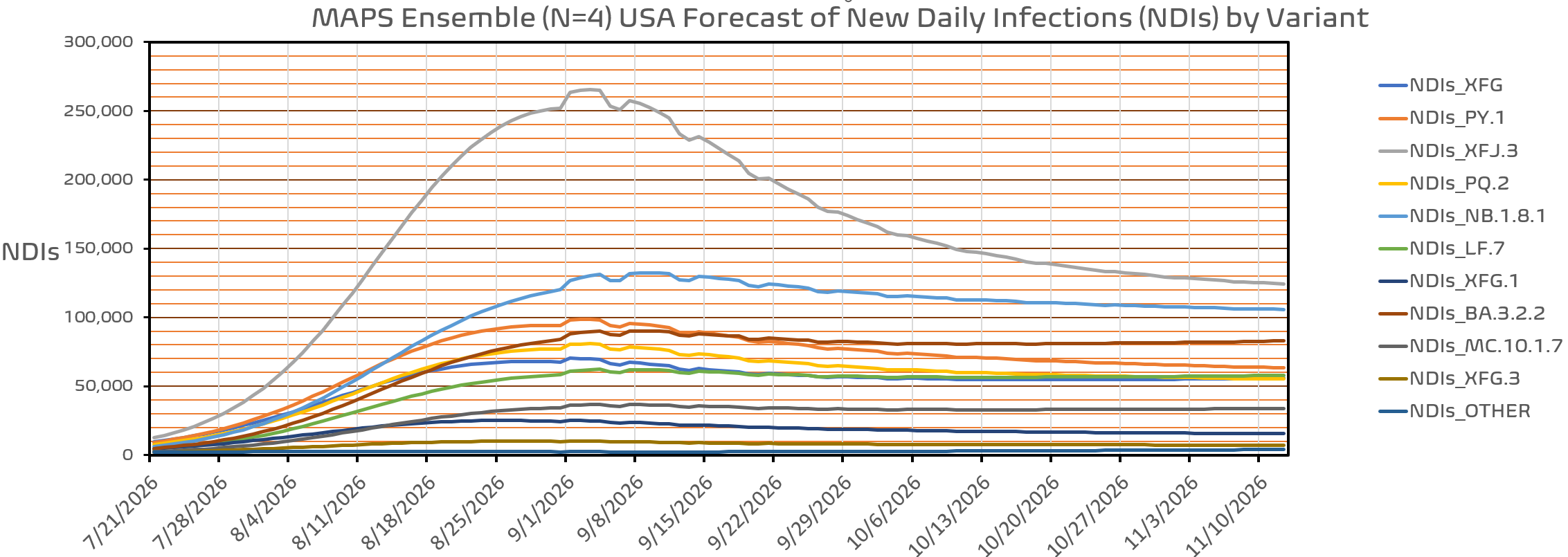
Selected active variants:
XFG share= 17.990% beta0_guess=0.17446386
PY.1 share= 15.842% beta0_guess=0.25946579
XFJ.3 share= 14.417% beta0_guess=0.26689971
PQ.2 share= 13.915% beta0_guess=0.25552717
NB.1.8.1 share= 8.844% beta0_guess=0.32564109
LF.7 share= 5.832% beta0_guess=0.24685718
XFG.1 share= 5.706% beta0_guess=0.19361494
BA.3.2.2 share= 5.376% beta0_guess=0.19904550
MC.10.1.7 share= 3.637% beta0_guess=0.20532365
XFG.3 share= 3.223% beta0_guess=0.23051626
OTHER share= 5.218% beta0_guess=0.17446386
Wrote: MAPS_FORECASTS/initial_conditions/maps_active_variants_07-12-2026.csv
Wrote: MAPS_FORECASTS/initial_conditions/maps_variant_fragment_07-12-2026.nml
Wrote: MAPS_FORECASTS/initial_conditions/maps_IC_07_12_2026.nc
Init date: 2026-07-12
History days: 500
Daily Global Pathogen and Outbreak Briefing - 2026-07-28
Executive Summary
- Highest-priority signal: the Bundibugyo Ebola outbreak in eastern Democratic Republic of the Congo remains the most consequential acute event. ECDC reported 2,905 confirmed DRC cases and 1,269 confirmed deaths as of 23 July, with 97 new confirmed cases and 62 deaths added from the previous day. Uganda has reported no new cases since 21 June and has begun its end-of-outbreak countdown, but regional spread risk remains elevated because of cross-border movement, insecurity, and incomplete transmission-chain visibility.
- Measles remains a major vaccine-preventable disease concern. CDC reported 2,318 confirmed U.S. cases as of 23 July, already exceeding the full-year 2025 total, with 93% of 2026 cases outbreak-associated. Globally, CDC/WHO data show large recent outbreaks across South Asia, the Middle East, the Americas, and Africa.
- Respiratory viruses remain mostly quiet globally and in the EU/EEA, with low SARS-CoV-2, RSV, and influenza activity overall. The main nuance is early COVID-19 growth signals in parts of the United States and pockets of elevated SARS-CoV-2, RSV, and influenza positivity in tropical and southern-hemisphere settings.
- Diphtheria in Australia remains notable because of its scale and local transmission in remote communities. Australian CDC reported 429 cases in 2026 as of 6 July, concentrated in the Northern Territory and Western Australia, with one probable diphtheria-associated death; recent national notifications appear to be slowing but recent weeks are incomplete.
- Other events worth monitoring: global cholera activity remains high with substantial new deaths; avian influenza A(H5) continues to pose a low but persistent zoonotic risk and is newly prominent in Australian wild seabirds; Europe has early-season West Nile virus activity, two CCHF cases in Spain, and a cluster of airport-associated malaria linked to Frankfurt Airport exposure.
Pathogen-by-Pathogen Briefing
1. SARS-CoV-2
Status: Low global activity overall, with regional pockets and early U.S. summer growth signals.
Notable countries/regions:
- Global: WHO reported SARS-CoV-2 positivity low and stable across most reporting countries in week 28, with elevated positivity above 10% in countries in Central America and the Caribbean and single countries in Tropical South America, Western Asia, and South-East Asia.
- EU/EEA: ECDC reported SARS-CoV-2 activity low across all age groups in primary and secondary care settings in week 29.
- United States: CDC reported national COVID-19 activity low and stable as of 24 July, but with early signs of increase in the West and South. CDC modeling estimated infections growing or likely growing in 37 states as of 22 July.
Severity: Low globally; Moderate watch in U.S. regions with growth signals.
Trend: Stable globally; worsening/early increase in parts of the United States.
Why it matters now: The current burden is low, but growth signals can precede healthcare impacts, especially for older adults and immunocompromised people.
2. Measles
Status: High public-health significance due to sustained outbreak activity and vaccination-gap implications.
Notable countries/regions:
- United States: CDC reported 2,318 confirmed measles cases in 2026 as of 23 July, including cases reported by 45 jurisdictions and 16 cases among international visitors. CDC reported 35 new outbreaks in 2026, with 93% of confirmed cases outbreak-associated. The 2026 count has already exceeded the 2,289 confirmed U.S. cases reported for all of 2025.
- Global: CDC/WHO monthly data covering December 2025-May 2026 listed the largest outbreak totals in Bangladesh, India, Yemen, Mexico, Pakistan, Cameroon, Kazakhstan, Guatemala, Angola, and Sudan.
Severity: High.
Trend: Worsening.
Why it matters now: The scale and geographic breadth of measles transmission point to immunity gaps and cross-border seeding risk; the U.S. surge is especially important because elimination status depends on interruption of endemic transmission.
3. Pertussis
Status: No major new global escalation identified today; continued circulation at lower levels than recent post-pandemic peaks.
Notable countries/regions:
- United States: CDC’s pertussis surveillance page says preliminary 2026 case counts are lower than the same period in 2025, and CDC’s respiratory data channel notes whooping cough continues to circulate below post-pandemic peaks.
- Americas: PAHO’s March update remains relevant background for elevated regional attention, but no new late-July regional escalation was identified in today’s scan.
Severity: Low to Moderate, depending on local infant vulnerability and vaccination coverage.
Trend: Stable to improving in the United States; unclear globally.
Why it matters now: Pertussis can produce severe disease in infants, and waning immunity plus under-vaccination can drive local rebounds even when national signals are quieter.
4. Ebola
Status: Active high-severity Bundibugyo Ebola outbreak centered in eastern DRC; Uganda appears to be moving toward outbreak closure if no further transmission occurs.
Notable countries/regions:
- Democratic Republic of the Congo: ECDC reported 2,905 confirmed cases and 1,269 confirmed deaths as of 23 July, based on data through 22 July. Ituri remains the main focus, with additional affected health zones in North Kivu, South Kivu, Haut-Uele, and Tshopo.
- Uganda: 20 confirmed cases and two deaths have been reported; no new cases since 21 June. Uganda discharged its last patient on 16 July and began the 42-day countdown toward declaring the outbreak over.
- International evacuations: ECDC noted medically evacuated or precautionary cases/contacts involving Germany, France, Czechia, and the United Kingdom in connection with humanitarian/healthcare exposure in DRC.
Severity: High.
Trend: Worsening in DRC; improving in Uganda; regional risk remains high.
Why it matters now: Bundibugyo virus has no licensed vaccine or specific treatment, response is complicated by insecurity and humanitarian conditions, and neighboring countries remain at risk through population movement and uncertain transmission chains.
5. Diphtheria
Status: Significant ongoing outbreak in Australia, with evidence of recent plateau/slowing but continued transmission in remote and very remote communities.
Notable countries/regions:
- Australia: Australian CDC reported 429 diphtheria notifications in 2026 as of 6 July, including 426 confirmed and three probable cases. Most cases were in the Northern Territory and Western Australia, with smaller numbers in South Australia and Queensland. About 65% were cutaneous and 32.4% respiratory; one 2026 death was probably diphtheria-associated.
- Northern Territory and Western Australia: These remain the main affected jurisdictions. The outbreak is concentrated among Aboriginal and Torres Strait Islander people and remote/very remote communities. Genomic analysis indicates recent cases across WA, NT, SA, and Queensland are linked in the AU-2026 outbreak group.
Severity: Moderate.
Trend: Stable to improving, with caution because recent-week data are incomplete.
Why it matters now: Locally acquired respiratory diphtheria is rare in Australia, and the outbreak highlights booster timing, remote-community access, contact tracing, and vaccination response needs.
6. RSV
Status: Low globally overall, with localized elevated positivity in some tropical/southern settings.
Notable countries/regions:
- Global: WHO reported RSV positivity low globally in week 28, but elevated above 10% in a few countries in Central America and the Caribbean and in Tropical and Temperate South America; positivity exceeded 30% in single countries in Eastern Africa and Southern Asia.
- EU/EEA: ECDC reported RSV activity low and at inter-seasonal levels in week 29.
- United States: CDC reported RSV activity very low in most areas as of 24 July, with low emergency department visits and hospitalizations; infants and children younger than 4 remain the highest-burden group.
Severity: Low globally, with Moderate local pediatric watch where positivity is elevated.
Trend: Stable globally; localized increases.
Why it matters now: RSV is currently out of season in many temperate regions, but localized activity can still affect pediatric capacity and should be tracked ahead of seasonal transitions.
7. Influenza A
Status: Seasonal influenza A activity remains low globally, but zoonotic influenza A(H5) remains a watch item.
Notable countries/regions:
- Global seasonal influenza: WHO reported global influenza detections low in week 28, with influenza B predominant overall. In zones with elevated influenza positivity, influenza A(H3N2) predominated in Central America/Caribbean and Middle Africa, A(H1N1)pdm09 in Southern Asia, and A(H1N1)pdm09/A(H3N2) co-dominance in Western and South-East Asia.
- EU/EEA: ECDC reported influenza activity low and inter-seasonal in week 29.
- United States: CDC reported seasonal influenza activity low as of 24 July.
- Avian influenza A(H5): CDC continues to assess current U.S. public-health risk as low while monitoring exposed people. H5 remains widespread in wild birds worldwide and associated with poultry and U.S. dairy-cattle outbreaks plus sporadic worker infections. Recent reporting from Australia points to H5 detections in wild seabirds across multiple states, raising wildlife and poultry biosecurity watch concerns, though human risk is described as low and no poultry involvement was identified in the official summaries reviewed.
Severity: Low for seasonal influenza A; Moderate watch for zoonotic A(H5).
Trend: Seasonal influenza stable/low; A(H5) geographically dynamic in animals.
Why it matters now: Seasonal burden is low, but A(H5) remains important because animal spread can increase exposure opportunities and requires ongoing surveillance for mammalian adaptation or human clusters.
8. Influenza B
Status: Low global activity, but currently predominant among low-level global influenza detections.
Notable countries/regions:
- Global: WHO reported influenza B viruses were predominant among influenza detections in week 28, with influenza B predominating in Tropical South America and Western Africa among zones with elevated positivity. Influenza A and B were co-dominant in Temperate South America, Southern Africa, and Eastern Asia.
- EU/EEA and United States: Influenza activity remains low/inter-seasonal.
Severity: Low.
Trend: Stable.
Why it matters now: Influenza B is the leading type among current low-level detections globally, so it should stay on the respiratory-virus watchlist even while overall burden is low.
Other Outbreaks of Interest
1. Cholera
Status: Multi-country activity remains high.
Notable countries/regions:
- ECDC’s monthly update reported 19,659 new cholera cases and 261 deaths globally between 26 May and 22 June. The five countries reporting the most new cases were Nigeria, DRC, Angola, Malawi, and Burundi; the most new deaths were reported by DRC, Nigeria, Angola, Congo, and Mozambique.
- Since 1 January 2026 and as of 22 June, ECDC reported 105,813 cholera cases and 1,216 deaths worldwide.
Severity: High.
Trend: Worsening in the latest monthly interval compared with the prior reporting period.
Why it matters now: High death counts and multiple affected countries indicate water/sanitation stress, response-capacity pressure, and risk of cross-border or travel-associated spread.
2. Dengue
Status: Regionally active, with localized transmission signals in Europe and substantial burden in the Americas.
Notable countries/regions:
- EU/EEA: ECDC reported one locally acquired dengue case in France in 2026 as of 22 July, with one new case reported that week.
- Americas: PAHO reported more than 1.2 million suspected dengue cases in the Region of the Americas through epidemiological week 22 of 2026.
Severity: Moderate.
Trend: Seasonal/worsening in some areas; unclear globally.
Why it matters now: Dengue remains a large-burden arboviral threat, and locally acquired European cases are important early indicators during vector season.
3. West Nile Virus, Europe
Status: Seasonal activity underway.
Notable countries/regions:
- ECDC reported 35 affected areas across six European countries as of 22 July: Italy, Greece, Romania, North Macedonia, Spain, and France.
Severity: Moderate.
Trend: Seasonal increase.
Why it matters now: The transmission season is active, and older adults are at highest risk of neuroinvasive disease.
4. Crimean-Congo Haemorrhagic Fever, Europe
Status: Limited but important seasonal signal.
Notable countries/regions:
- ECDC reported two locally acquired CCHF cases in Spain in 2026 as of 22 July.
Severity: Moderate.
Trend: Stable/limited signal.
Why it matters now: CCHF has high severity potential and requires tick-exposure awareness, infection prevention, and rapid clinical recognition.
5. Airport-Associated Malaria, Germany
Status: Unusual cluster under investigation.
Notable countries/regions:
- ECDC reported four Plasmodium falciparum malaria cases among people who worked at Frankfurt International Airport before symptom onset between 4 and 6 July; none had travel to malaria-endemic areas. Investigations include risk communication, vector monitoring, genomic analyses, and case finding.
Severity: Moderate.
Trend: Unclear.
Why it matters now: Airport malaria is rare but clinically important; unexplained fever after relevant airport exposure should prompt consideration of malaria even without travel.
6. Mpox
Status: Ongoing global outbreak response, but no major new late-July escalation identified in today’s scan.
Notable countries/regions:
- WHO’s latest external situation report available in this scan covered global mpox epidemiology through 31 May and Africa through 14 June, with operational response updates through 17 June.
Severity: Moderate.
Trend: Unclear from today’s public updates.
Why it matters now: Mpox remains relevant because of ongoing multi-country transmission and risk during large gatherings, but today’s briefing did not identify a major new event requiring elevation beyond watch status.
Watchlist
- SARS-CoV-2: Watch for whether early U.S. growth signals in the West and South translate into increased hospitalizations or broader wastewater/test positivity increases.
- Measles: Watch U.S. outbreak-associated transmission, state-level acceleration, and global importation risk tied to large outbreaks in Bangladesh, India, Yemen, Mexico, Pakistan, Cameroon, Kazakhstan, Guatemala, Angola, and Sudan.
- Ebola Bundibugyo: Watch DRC case growth, contact follow-up coverage, affected health-zone expansion, cross-border alerts, and Uganda’s 42-day countdown.
- Diphtheria: Watch Australia’s NT/WA trend, respiratory-case counts, hospitalization signals, vaccination/booster response, and spread outside remote outbreak areas.
- Cholera: Watch DRC, Nigeria, Angola, Congo, and Mozambique mortality trends and any sharp increases after the next WHO/ECDC monthly update.
- Avian influenza A(H5): Watch animal detections in Australia, U.S. dairy/poultry-linked exposure monitoring, human clusters, severity changes, and any evidence of sustained mammal-to-mammal or human-to-human transmission.
- Dengue/West Nile/CCHF: Watch seasonal vector-borne expansion in Europe and the Americas.
References
- WHO Global Respiratory Virus Activity Weekly Update No. 587, week 28 ending 12 July 2026: https://cdn.who.int/media/docs/default-source/influenza/influenza-updates/2026/202628_rvupdate_587.pdf
- WHO COVID-19 dashboard summary, week of 22-28 June 2026: https://data.who.int/dashboards/covid19/summary
- CDC Respiratory Illnesses Data Channel, updated 24 July 2026: https://www.cdc.gov/respiratory-viruses/data/index.html
- CDC Current Epidemic Trends based on Rt, updated 24 July 2026: https://www.cdc.gov/cfa-modeling-and-forecasting/rt-estimates/index.html
- CDC Measles Cases and Outbreaks, updated 24 July 2026: https://www.cdc.gov/measles/data-research/index.html
- CDC Global Measles Outbreaks, updated 14 July 2026: https://www.cdc.gov/global-measles-vaccination/data-research/global-measles-outbreaks/index.html
- CDC Pertussis Surveillance and Trends: https://www.cdc.gov/pertussis/php/surveillance/index.html
- WHO Ebola outbreak - DRC 2026 situation page: https://www.who.int/emergencies/situations/ebola-outbreak---drc-2026
- ECDC Communicable Disease Threats Report, Week 30, 18-24 July 2026: https://www.ecdc.europa.eu/en/publications-data/communicable-disease-threats-report-18-24-july-2026-week-30
- Australian Centre for Disease Control, Diphtheria in Australia epidemiological update as at 6 July 2026: https://www.cdc.gov.au/sites/default/files/2026-07/20260707-diphtheria_epi_summary_-_web.pdf
- CDC A(H5) Bird Flu Current Situation: https://www.cdc.gov/bird-flu/situation-summary/index.html
- WHO Western Pacific avian influenza surveillance page: https://www.who.int/westernpacific/wpro-emergencies/surveillance/avian-influenza
- ECDC Cholera worldwide overview, monthly update as of 22 June 2026: https://www.ecdc.europa.eu/en/all-topics-z/cholera/surveillance-and-disease-data/cholera-monthly
- WHO Multi-country outbreak of mpox, External Situation Report #67, 26 June 2026: https://www.who.int/publications/m/item/multi-country-outbreak-of-mpox--external-situation-report--67---26-june-2026
- PAHO Dengue epidemiological situation in the Region of the Americas, EW 22 2026: https://www.paho.org/en/documents/dengue-epidemiological-situation-region-americas-epidemiological-week-22-2026
Closing: What to Monitor Next
- Whether DRC Ebola daily additions remain near or above late-July levels, and whether the share of contacts under follow-up improves.
- Whether Uganda completes the 42-day Ebola clearance period without further cases.
- U.S. measles state dashboards for sustained transmission and any new large outbreaks.
- Next WHO respiratory-virus update for signs of increasing influenza, RSV, or SARS-CoV-2 activity in the southern hemisphere and tropics.
- Australia’s next diphtheria update for confirmation that notifications are continuing to slow and that respiratory cases are not increasing.
- Cholera mortality and case growth in DRC, Nigeria, Angola, Congo, Mozambique, and Malawi.
Keep up your kindness and hopefully help someone with Long Covid or prevent it by encouraging masking, boosting, and clean air!
Take care,
Joe

I should be wearing a mask for my emoji on X, but I was in the middle of a lake when I took this.