

Pathogen Update: 8-5-2026
Daily Update

A new MAPS forecast will be ready by tomorrow. Here is this week's update of GISAID+Wastewater-Derived NDIs. Is this the last hurrah for XGF? It appears to have driven the last increase at the national level, from 18% to 31%. Meanwhile, XFJ.3 has climbed to 2nd. Swapping places with PY.1. NB.1.8.1 has increased slightly and s topped by PQ.2 now. We are all keeping our eye on PJ.2.1, which has shown rapid spread in other parts of the globe and has been detected in 10 states as well as Ontario, Canada.
@LongDesertTrain did a deep dive and showed the samples match extremely closely. It spells trouble.
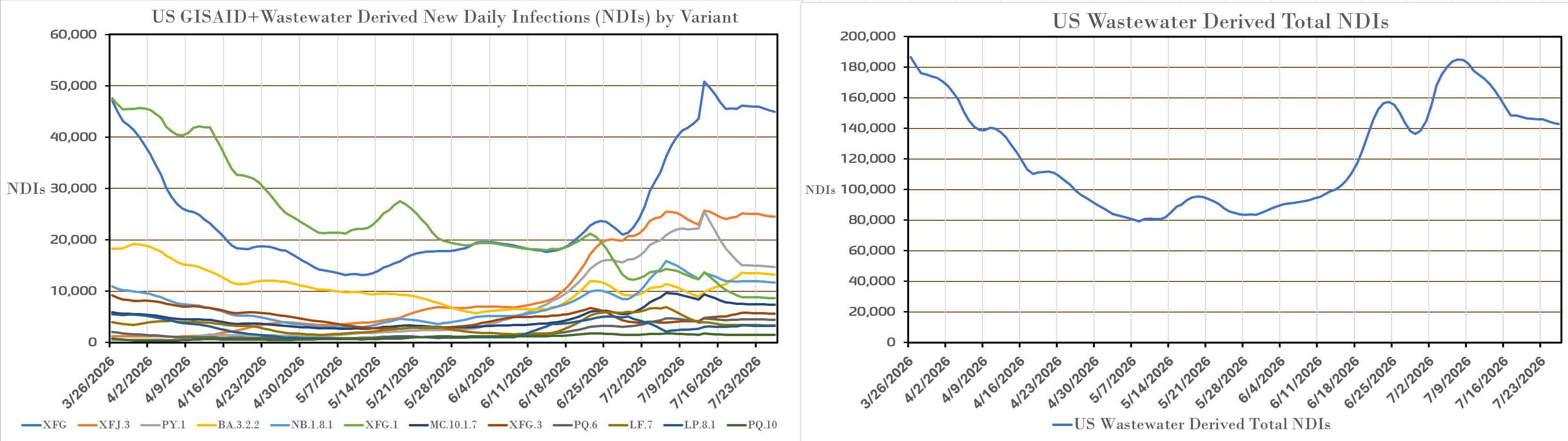
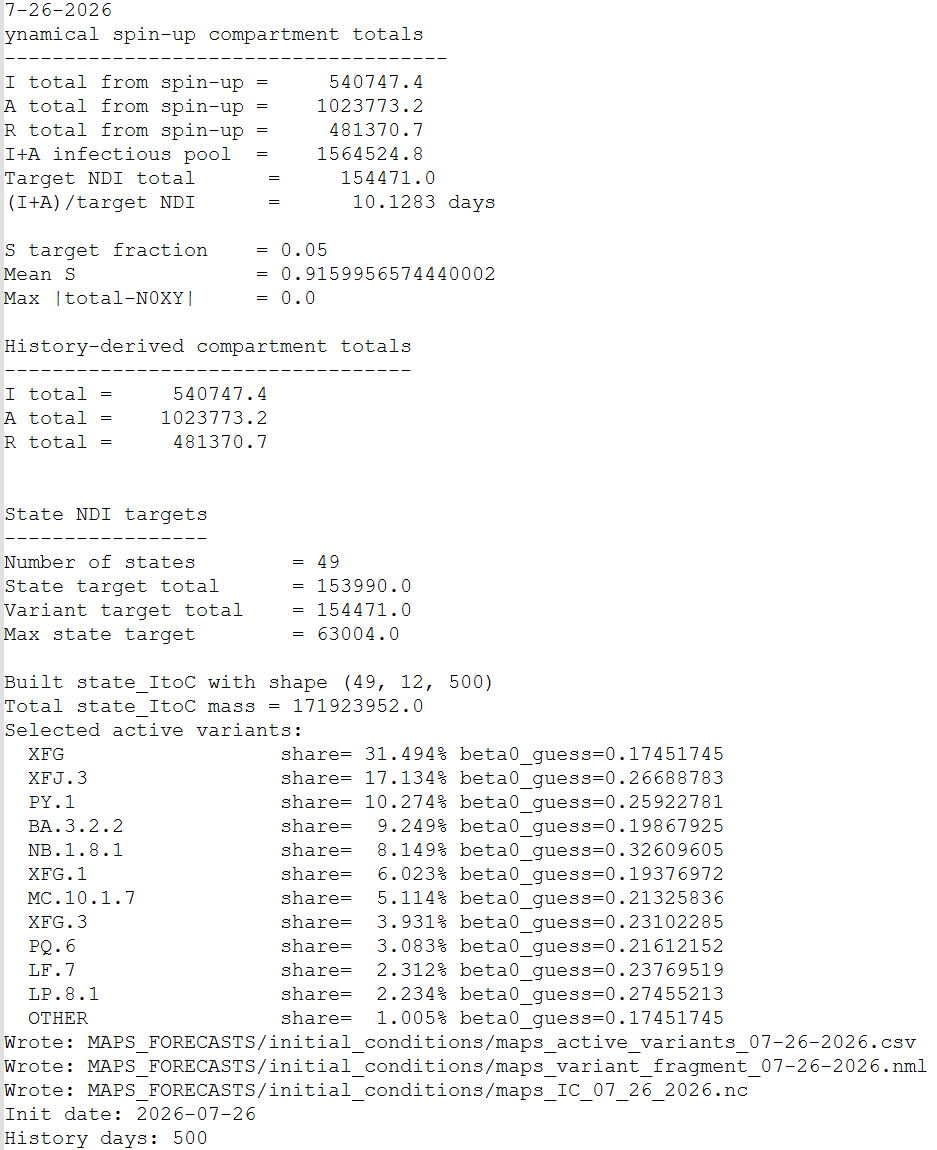
This is the output from the MAPS Initial Condition Builder displaying the current variant status and transmission strengths.
Daily Global Pathogen and Outbreak Briefing - 2026-08-05
Executive Summary
- Bundibugyo Ebola in eastern Democratic Republic of the Congo (DRC) remains the leading global outbreak emergency. New reporting on 4 August described approximately 1,700 deaths, up from more than 1,500 in reporting available a day earlier. WHO’s latest formal situation report, with data through 26 July, documented intensifying transmission, rising mortality, and geographic expansion. The exact totals are fast-moving and provisional.
- Measles remains High and worsening. The United States has recorded more than 2,300 cases in 2026, already exceeding all of 2025. A new analysis estimated that New Mexico’s 2025 outbreak alone cost $5.4 million, underscoring the operational and economic burden of preventable transmission.
- SARS-CoV-2 activity remains low globally, but a U.S. summer increase is under way. WHO has added PQ.16.1.1 to its variants-under-monitoring list; this indicates a surveillance signal, not evidence of increased severity.
- Seasonal influenza and RSV remain low in most temperate regions. Zoonotic influenza A deserves closer attention: China reported four additional human H9N2 infections, bringing the reported six-month total to 20, while Australia continues to detect H5N1 in wild birds.
- Other continuing priorities are multi-country cholera, the large and fragmented U.S. Cyclospora outbreak situation, mpox, and seasonal vector-borne threats in Europe.
Pathogen-by-Pathogen Briefing
1. SARS-CoV-2
Status: Low global burden, with a developing U.S. summer increase.
Notable countries/regions:
- United States: Low but rising activity has been reported across all four regions. Severe illness remains low, but regional growth warrants attention.
- Global: WHO’s latest available respiratory-virus update showed low activity overall, with localized higher positivity in tropical settings.
- Variant surveillance: WHO added PQ.16.1.1 as a variant under monitoring as of 27 July, alongside NB.1.8.1, XFG, and BA.3.2. Monitoring status alone does not establish greater severity or immune escape.
- EU/EEA: Activity remains low and inter-seasonal.
Severity: Moderate watch in the United States; Low globally.
Trend: Worsening in the United States; stable or unclear elsewhere.
Why it matters now: Broad U.S. growth can precede increased hospital burden, while the new variant designation highlights the importance of genomic and severity surveillance.
2. Measles
Status: Sustained high-significance transmission driven by immunity gaps.
Notable countries/regions:
- United States: More than 2,300 cases have been reported in 2026, already above the full-year 2025 total and the highest annual burden since the early 1990s. Most cases are outbreak-associated.
- New Mexico: A newly reported analysis estimated that the state’s 2025 outbreak cost $5.4 million in medical care, lost productivity, and public-health response.
- Florida: 155 cases have been reported against a historical annual average of roughly 3 to 4.
- Canada: Prolonged continuous transmission has resulted in loss of elimination status.
- Global: Large recent outbreaks in Bangladesh, India, Yemen, Mexico, Pakistan, Cameroon, Kazakhstan, Guatemala, Angola, and Sudan continue to create importation pressure.
Severity: High.
Trend: Worsening.
Why it matters now: Persistent transmission, hospitalizations, school-level coverage gaps, and high response costs show that the problem extends well beyond the formal question of elimination status.
3. Pertussis
Status: Continued circulation, but no major new global escalation identified today.
Notable countries/regions:
- United States: Preliminary 2026 activity remains below the same period in 2025 and below the recent post-pandemic peak.
- No new late-July or early-August cross-border surge was verified in the available reporting.
Severity: Low to Moderate.
Trend: Stable to improving in the United States; unclear globally.
Why it matters now: Young infants remain at highest risk of severe disease, and local outbreaks can accelerate where maternal vaccination or childhood coverage is weak.
4. Ebola
Status: Rapidly worsening Bundibugyo Ebola virus disease outbreak in eastern DRC.
Notable countries/regions:
- DRC: Reporting published 4 August described approximately 1,700 deaths. WHO’s latest formal report, with data through 26 July, documented intensifying transmission, increasing mortality, and geographic expansion. The outbreak is the largest recorded Bundibugyo virus outbreak.
- Response indicators: Recent specialist reporting estimated that about 80% of cases were not linked to known contacts and roughly 60% of deaths occurred in the community, indicating that surveillance and referral systems are being outpaced.
- Operational constraints: Armed-group activity and healthcare-worker strikes in North Kivu and Ituri continue to impede contact tracing, treatment access, safe burial, and community engagement.
- Uganda: The incursion appears contained at about 20 cases, with the country progressing through its 42-day end-of-outbreak countdown. Reporting differs on the exact start date of that period.
- Regional risk: No new country was reported affected overnight, but population movement and incomplete transmission-chain visibility keep neighboring countries on high alert.
Severity: High.
Trend: Worsening rapidly in DRC; improving in Uganda; regional risk remains elevated.
Why it matters now: Rapid growth, community deaths, unlinked transmission, insecurity, and the absence of a licensed Bundibugyo-specific vaccine or treatment make continued expansion likely without major operational improvement.
Uncertainty note: Current totals are changing quickly. The approximately 1,700-death figure comes from recent medical reporting; WHO’s formal situation reports remain the preferred source for consolidated counts.
5. Diphtheria
Status: Significant Australian outbreak continues; no verified new acceleration today.
Notable countries/regions:
- Australia: The Australian CDC reported 429 notifications as of 6 July, concentrated in the Northern Territory and Western Australia. Most cases occurred among Aboriginal and Torres Strait Islander people in remote and very remote communities. About one-third were respiratory, and one death was considered probably diphtheria-associated.
- Genomic evidence links cases across Western Australia, Northern Territory, South Australia, and Queensland within the 2026 outbreak group.
Severity: Moderate.
Trend: Stable to possibly improving; recent-week data remain incomplete.
Why it matters now: Locally acquired respiratory diphtheria is unusual in Australia and exposes vaccination, booster, healthcare-access, contact-management, and antitoxin-logistics gaps.
6. RSV
Status: Low overall; no major update worth elevating today.
Notable countries/regions:
- United States and EU/EEA: Activity remains very low or inter-seasonal.
- Tropical and southern settings: Localized higher positivity persists in parts of Central and South America and isolated areas of Africa and Southern Asia.
Severity: Low globally; Moderate local pediatric watch where positivity is elevated.
Trend: Stable overall; localized increases.
Why it matters now: Infants remain the main severe-disease group, and localized activity can pressure pediatric services outside the usual temperate peak.
7. Influenza A
Status: Seasonal activity is low; zoonotic influenza signals merit attention.
Notable countries/regions:
- China: Four additional human H9N2 infections were reported, bringing the total reported over the past six months to 20. H9N2 infections are generally sporadic and linked to poultry exposure, but the frequency warrants continued investigation.
- Australia: Additional H5N1 detections have been reported in wild birds.
- United States: H5 viruses remain a concern in wild birds, poultry, and dairy cattle, with occupational-exposure monitoring continuing.
- Seasonal influenza A: Activity remains low in the United States and EU/EEA. A(H3N2) has predominated in parts of Central America/Caribbean and Middle Africa, while A(H1N1)pdm09 has been prominent in Southern Asia.
- No evidence of sustained human-to-human transmission of H5 or H9N2 was identified in the reporting reviewed.
Severity: Low for seasonal influenza A; Moderate for zoonotic influenza watch.
Trend: Seasonal activity stable/low; animal and sporadic human detections remain geographically dynamic.
Why it matters now: Repeated human H9N2 infections and continued H5N1 animal spread increase opportunities for viral adaptation and require rapid investigation of clusters or unexplained severe respiratory illness.
8. Influenza B
Status: Low global activity; no major update worth elevating today.
Notable countries/regions:
- Influenza B remains predominant among low-level global detections, including in Tropical South America and Western Africa.
- United States and EU/EEA activity remains low/inter-seasonal.
Severity: Low.
Trend: Stable.
Why it matters now: The absolute burden is low, but B-virus predominance remains relevant to southern-hemisphere surveillance and planning for the next northern-hemisphere season.
Other Outbreaks of Interest
1. Cholera
Status: Broad multi-country increase continues.
- WHO’s latest consolidated update reported 29,610 new cholera or acute watery diarrhoea cases from 16 countries during May, 43% more than the previous month.
- Reported deaths rose 30% to 271, with the largest burden in the Eastern Mediterranean and African regions.
Severity: High.
Trend: Worsening in the latest consolidated interval.
Why it matters now: Conflict, displacement, flooding, and damaged water and sanitation systems are increasing incidence and delaying access to life-saving rehydration.
2. Cyclospora, United States
Status: Very large, fragmented foodborne outbreak situation.
- Recent specialist reporting described about 11,000 cases and two deaths, likely representing four to six distinct outbreaks.
- Taylor Farms-linked lettuce may account for part of the burden, but other clusters may involve cilantro, parsley, travel, or unresolved sources.
Severity: Moderate.
Trend: Worsening or unclear while clusters and food vehicles are separated.
Why it matters now: The scale, multiple suspected vehicles, delayed traceability, and fragmented communication prolong exposure uncertainty.
3. Mpox
Status: Ongoing multi-country transmission without a major new early-August escalation identified.
Severity: Moderate.
Trend: Stable or unclear globally.
Why it matters now: Continued transmission requires sustained case detection, vaccination, and clinical vigilance, particularly in affected African settings and travel networks.
4. European vector-borne threats
Status: Seasonal activity is established.
- West Nile virus activity has been reported in Italy, Greece, Romania, North Macedonia, Spain, and France.
- Spain has reported two locally acquired Crimean-Congo haemorrhagic fever cases in 2026.
- A rare cluster of airport-associated Plasmodium falciparum malaria linked to Frankfurt Airport exposure remains under investigation.
Severity: Moderate.
Trend: Seasonal increase for West Nile virus; limited or unclear for CCHF and airport malaria.
Why it matters now: Peak vector season increases the likelihood of geographic expansion and severe neuroinvasive or haemorrhagic disease in vulnerable people.
Watchlist
- SARS-CoV-2: Always monitor. Watch U.S. hospitalizations, wastewater, emergency-department visits, and the epidemiology of PQ.16.1.1.
- Measles: Always monitor. Watch U.S. outbreak duration, hospitalizations, local vaccine gaps, importations, and elimination-status implications.
- Ebola Bundibugyo: Watch formal WHO case/death totals, unlinked cases, community deaths, geographic expansion, healthcare-worker strike resolution, border alerts, and Uganda’s clearance countdown.
- Influenza A(H9N2/H5N1): Watch additional human H9N2 cases in China, Australian H5N1 wildlife detections, U.S. mammalian outbreaks, exposed-worker infections, and any human cluster.
- Diphtheria: Watch Australia’s Northern Territory and Western Australia for respiratory cases, deaths, and sustained decline.
- Cholera: Watch mortality in the Eastern Mediterranean and African regions.
- Cyclospora: Watch for clear separation of outbreaks, identified food vehicles, recalls, and updated severe-outcome totals.
- West Nile virus/CCHF: Watch geographic expansion during the European vector season.
References
- WHO Ebola Bundibugyo virus disease outbreak report, DRC: https://www.afro.who.int/countries/democratic-republic-of-congo/publication/ebola-bundibugyo-virus-disease-outbreak-3
- WHO SARS-CoV-2 variant tracking: https://www.who.int/activities/tracking-SARS-CoV-2-variants/
- WHO Global Respiratory Virus Activity Weekly Update No. 587: https://www.who.int/publications/m/item/global-respiratory-virus-activity-weekly-update-n-587
- WHO COVID-19 dashboard: https://data.who.int/dashboards/covid19/summary
- CDC Respiratory Illnesses Data Channel: https://www.cdc.gov/respiratory-viruses/data/index.html
- CDC Measles Cases and Outbreaks: https://www.cdc.gov/measles/data-research/index.html
- CDC Global Measles Outbreaks: https://www.cdc.gov/global-measles-vaccination/data-research/global-measles-outbreaks/index.html
- CDC Pertussis Surveillance and Trends: https://www.cdc.gov/pertussis/php/surveillance/index.html
- CDC A(H5) Bird Flu Current Situation: https://www.cdc.gov/bird-flu/situation-summary/index.html
- WHO Cholera Epidemiological Update No. 38: https://www.who.int/publications/m/item/multi-country-outbreak-of-cholera-epidemiological-update-38-30-june-2026
- ECDC Communicable Disease Threats Reports: https://www.ecdc.europa.eu/en/publications-data/communicable-disease-threats-report
- Australian CDC diphtheria epidemiological update: https://www.cdc.gov.au/sites/default/files/2026-07/20260707-diphtheria_epi_summary_-_web.pdf
- CIDRAP, 4 August 2026 daily reporting, including H9N2/H5N1 and measles-response costs: https://www.cidrap.umn.edu/news
- MedPage Today, 4 August 2026, Ebola mortality update: https://www.medpagetoday.com/infectiousdisease/ebola/122474
Source note: The general web-search service was unavailable during this run. This briefing uses directly accessible authoritative surveillance baselines, current public-health and medical reporting in the connected mailbox, and the prior briefing’s verified source trail. Fast-moving Ebola and Cyclospora figures are labeled provisional.
What to Monitor Next
- WHO’s next consolidated DRC Ebola count and whether transmission-chain visibility improves.
- Whether Uganda completes its Ebola clearance period without a new case.
- The next CDC measles update and any new sustained U.S. transmission chains.
- Whether the U.S. COVID increase translates into higher hospital or emergency-department burden.
- Additional H9N2 human infections in China or H5N1 detections in mammals and exposed people.
- The next WHO respiratory-virus update for southern-hemisphere influenza and RSV movement.
- Australia’s next diphtheria report and Cyclospora source attribution or recalls.
Keep up your kindness and hopefully help someone with Long Covid or prevent it by encouraging masking, boosting, and clean air!
Take care,
Joe
I should be wearing a mask for my emoji on X, but I was in the middle of a lake when I took this.